Diamond Rings
 Black Diamond Rings
 Emerald Rings
 Pink Sapphire Rings
 Ruby Rings
 Sapphire Rings
 Amethyst Rings
 Aquamarine Rings
 Citrine Rings
 Garnet Rings
 Morganite Rings
 Peridot Rings
 Rhodolite Rings
 Tanzanite Rings
 Topaz Rings


Emerald Meaning: Symbolism, History & Why It’s the Stone of Renewal
Emeralds have never really gone out of style.
There's something about this stone that feels alive, deep, rich green, and full of character.
Across cultures and centuries, people have associated emeralds with the same themes: renewal, growth, love, and wisdom.
That's not a coincidence.
Throughout history, emeralds have symbolized qualities people value most.
Understanding what emeralds represent helps explain why certain things resonate with us on a level beyond appearance, and why this particular gemstone has captivated so many people for so long.
In this article, we'll explore the emerald’s meaning, symbolism, and enduring appeal of emeralds.
What Does Emerald Mean?
The word "emerald" comes from the Greek smaragdos, which simply means "green gem."
But the meaning that built up around the stone over thousands of years is much richer than that simple origin.
Emerald's meaning has always been about life.
Think about what that green color actually stands for in nature. New leaves after a long winter, the first shoots pushing through the soil, the moment a landscape that looked dead suddenly isn't.
Emerald carries all of that.

The meanings that show up most consistently across cultures:
- Renewal and growth - starting fresh, beginning something new, the energy of new seasons
- Prosperity and abundance - not just wealth, but genuine flourishing in all areas of life
- Wisdom and clarity - being able to see a situation clearly and know what to do
- Harmony and balance - a grounding, steadying quality that many people describe when they wear the stone
What's striking is how consistently these themes appear across civilizations that had no contact with each other.
That kind of pattern usually means something.
There's something about the emerald, its color and character, that seems to suggest these ideas almost intuitively.
The Emerald Symbolism
Look at emerald symbolism through history and a few threads keep coming up: rebirth, hope, abundance, and the idea that renewal is always possible, no matter what came before.
Rebirth might be the oldest and most universal of these.
The emerald takes seasonal energy with spring returning, life coming back, and makes it permanent. It's a stone that says beginning, and not ending.
Hope works the same way.

There's a reason we say things are "looking green" when they're going well.
Green leans optimistic. The emerald concentrates that into something you can wear, give, or keep.
And then there's abundance.
Historically, emeralds have been tied to prosperity, not in a "get rich quick" way, but in the deeper sense of a life that's genuinely full.
Meaningful relationships, purposeful work, the feeling that things are growing in the right direction.
Emerald's Spiritual Meaning and What Different Cultures Believed
The spiritual meaning of emerald shifts slightly depending on which culture you look at, but the core ideas keep showing up no matter where you look.
In ancient Egypt
Emeralds were connected to Thoth, the god of wisdom and knowledge. They were buried with the dead as symbols of eternal youth and the promise of rebirth.
Cleopatra claimed entire emerald mines as her own. The Egyptians carved emeralds into amulets and gave them as gifts to foreign leaders. For a civilization so focused on the afterlife, the emerald's link to renewal was about being central.
The Romans
These people connected the stone to Venus, goddess of love and beauty, which is where much of the emerald's romantic symbolism comes from.
In Hindu tradition
Emeralds were linked to Mercury and associated with intelligence and eloquence. Medieval scholars in Europe wrote about emeralds as stones that could reveal truth. In Islamic tradition, the stone even appears in descriptions of paradise itself.

Today, people interpret the spiritual side of the emerald more personally, as a stone that represents clarity of purpose, emotional openness, and the kind of grounded optimism that makes real growth possible.
You don't need to follow any particular belief system for that to resonate. It's just what the stone seems to invite.
The Emerald’s History
The emerald's history stretches back more than four thousand years, and it's genuinely fascinating.
The oldest known emerald mines were in Egypt, near the Red Sea coast. These are now called Cleopatra's Mines because she claimed them as her personal property.
The Egyptians buried them with royalty, carved them into talismans, and gifted them to foreign rulers as a show of power and sophistication.
These weren't just pretty objects. They were meaningful ones.
The Romans got their emeralds from Egypt too, and the stone traveled through the empire as a prized luxury.

There's a famous story about Nero watching gladiatorial games through an emerald lens, historians still debate whether it was for his eyesight or simply because he loved the color.
Either way, it tells you how much the Romans valued the stone.
Then came the discovery that changed everything.
In the 16th century, Spanish conquistadors found emerald deposits in South America, specifically the Muzo and Chivor mines in what is now Colombia, and the stones they pulled from the earth were unlike anything Europe had ever seen.
Larger, more intensely colored, more extraordinary in every way.
Those Colombian emeralds flooded into Mughal treasuries, Habsburg collections, and the jewelry boxes of monarchs across the world. The gem trade was never the same.
Colombia still produces the world's finest emeralds. The Muzo mine in particular is known for a very specific quality: a warm, deeply saturated green with just a hint of blue or yellow, sometimes called "Colombian green."
It's the benchmark that everything else gets measured against.
Why Is Emerald Called the Stone of Renewal?
Nobody officially declared the emerald the "stone of renewal."
It's a title that built up over time, from multiple directions at once, because it kept being true.
Start with the color. Green sits in the middle of the visible spectrum, and human eyes are more sensitive to it than any other color. We're wired to notice green, and we're wired to associate it with life. The emerald takes that instinct and crystallizes it into something concentrated and permanent.

Then there's the spring connection. In cultures all over the world, green is the color of new beginnings. It means the first growth after winter, the return of warmth and possibility. Wearing an emerald is a little like carrying a piece of that feeling with you.
And then emerald itself. Fine emeralds almost always have natural inclusions inside them, gemologists call these jardins, from the French word for garden. These tiny internal landscapes of crystals and fractures are what make each stone completely one of a kind.
A diamond is prized for perfect clarity. An emerald is prized despite, or sometimes even because of, its internal complexity.
There's a metaphor that is worth sitting with: growth isn't perfect.
Neither is the stone. And somehow, that makes it more honest.
Emerald Meaning in Love and Relationships
The emerald's connection to love goes back at least to the Romans and their link to Venus, but it persisted because it kept feeling true.
Emeralds are about the kind of love that grows over time. The devotion that deepens. The relationship that becomes something you build your life around.
In medieval Europe, emeralds were given as tokens of fidelity.
There was even a folk belief that an emerald would lose its color if one partner was unfaithful, which isn't how gemstones actually work, but it tells you how seriously the stone's association with loyalty was taken.
Today, people choose emeralds for engagement rings and anniversary gifts because they want something that communicates depth rather than flash.
An emerald says: this is about who we are.
That resonates with a lot of couples.
Emerald as the May Birthstone
The emerald birthstone meaning fits almost too perfectly.
May is basically the definition of renewal.
Everything's growing, the cold is gone, the world is green again.
You couldn't design a more fitting match.
The formal birthstone list we use today was standardized in 1912 by the American National Retail Jewelers Association, but the emerald's connection to spring is far older than any official list.

Versions of birthstone traditions appear in ancient texts, from the twelve stones of the high priest's breastplate in Exodus to astrological gem charts in medieval Europe.
For someone born in May, an emerald is a genuinely personal gift, one that connects to who they are. It works for birthdays, graduations, anniversaries, the birth of a child, or any occasion where you want to give something that actually carries meaning.
And there's something to be said for a birthstone people actually want to wear. The emerald isn't a compromise. It's one of the most coveted gemstones in the world.
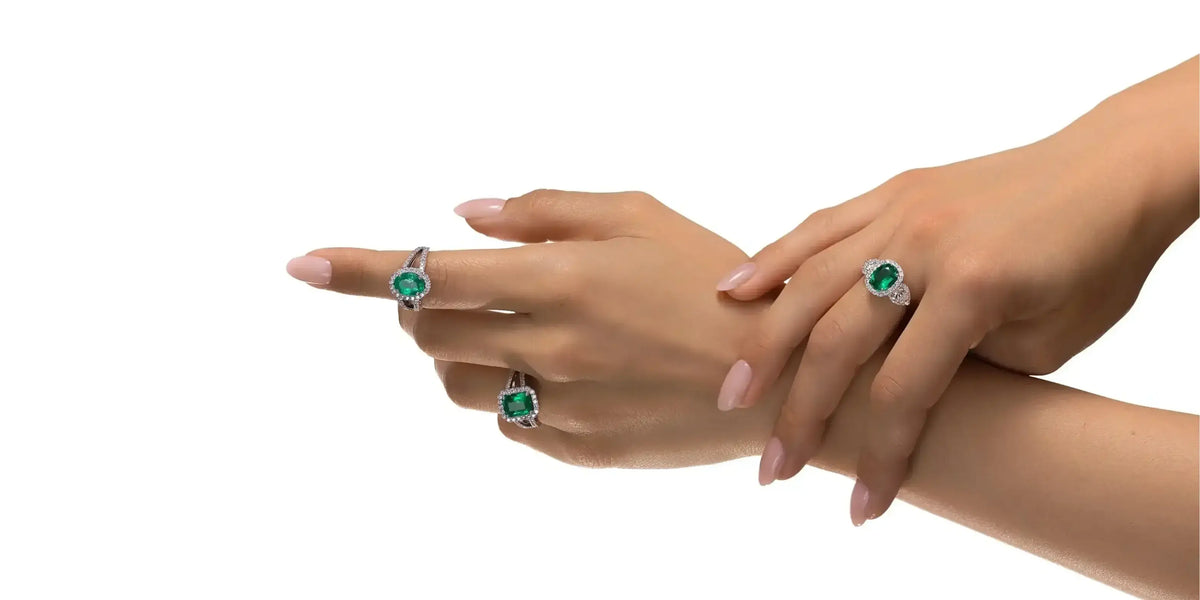
What Does an Emerald Ring Mean?
Emerald engagement rings have had a real cultural moment recently, as more couples look for something that feels personal rather than conventional.
An emerald engagement ring makes a different kind of statement than a diamond.
Not better or worse, just different.

That appeal to intentionality is a big part of the draw.
Celebrities have helped raise the profile like Jackie Kennedy's emerald engagement ring, Halle Berry's, Zoe Kravitz's.
But the real reason more couples are choosing emeralds is that they want their ring to reflect their actual values, not just a default choice.
As anniversary stones, emeralds mark the 20th and 35th anniversaries, representing real time and real history together.
And also, heirloom emerald jewelry carries something else entirely.
A ring passed down through generations is a thread connecting people across time, and an emerald, with all its layered meaning, is exactly the right stone to carry that weight.
Why Natural Emeralds Are Worth It
There are synthetic emeralds.
Lab-grown ones. Simulated ones.
And in a purely technical sense, a well-made synthetic emerald is chemically identical to a natural one.
But it doesn't have a story. It didn't form over millions of years under specific geological conditions in a specific place on earth. It doesn't have a jardin that belongs to it alone.
Natural gemstones are irreplaceable in a way that manufactured alternatives simply aren't. Each stone is the result of a completely unrepeatable sequence of events.
That uniqueness is part of what you're choosing when you choose natural.
At Gemnat, we work exclusively with natural gemstones because we believe the stone's story is inseparable from its meaning.
A natural emerald, carefully sourced, expertly set, chosen for its specific color and character, is a completely different object from something pulled off a shelf. If you're drawn to emeralds and want help finding or creating something that's genuinely yours, we'd love to talk.

Written by Gemnat Customer Service